


Wedding Marketing in 2027: What Venues and Suppliers Need to Prepare for Now
NB: To help you browse our best suggestions we have included some third party links. Some purchases made through these links may earn us a commission to help keep our blogs and offers current and up to date. Thanks for your support!
Wedding marketing is changing, but probably not in the way you might think.
Google isn’t disappearing. Instagram isn’t disappearing. Couples aren’t suddenly going to stop looking at beautiful wedding photography or reading reviews. What is changing is the way all of these things fit together as couples research, compare and ultimately choose the businesses they want to work with.
Search is becoming more conversational, social media is increasingly being used for discovery, artificial intelligence is changing how people find information and couples are expecting more useful information before they make contact.
For wedding venues and suppliers, 2027 is therefore less about chasing the next big platform and more about making sure your existing marketing works together.
Here are the changes worth preparing for now.
1. Search is becoming more conversational
For years, wedding SEO has centred around searches such as “London wedding venues”, “Manchester wedding photographer” or “wedding florist near me”.
Those searches still matter, but search is becoming much more conversational. Google’s AI Mode, now available in the UK, is designed to handle longer and more complex questions, with Google reporting that people using AI Mode are asking questions that are two to three times longer than traditional searches.
For a couple, that could mean moving from:
“London wedding venues”
to:
“What are the best exclusive-use wedding venues in London for around 80 guests with accommodation and an outdoor ceremony?”
That means your website needs to do more than target keywords. It needs to answer the questions couples actually have.
Can guests stay overnight? How many people can you accommodate? Do you allow outdoor ceremonies? What happens if it rains? Can couples choose their own suppliers? What is included? What does the venue cost?
Google’s own guidance is clear that there isn’t a special trick for appearing in AI search. The fundamentals of good SEO still matter: technically accessible websites, useful content, original information and a good user experience.
The takeaway: Don’t just create pages around keywords. Create useful content around the questions your couples are asking.
2. Original expertise is becoming more valuable
AI has made it incredibly easy to produce content. A business can generate dozens of social captions or blog ideas in a matter of minutes.
That also means generic content is becoming easier to spot.
A blog called “10 Tips for Planning Your Perfect Wedding” doesn’t contain much that is unique. A venue sharing what it has learned from hosting hundreds of real weddings does. This is where wedding businesses have a genuine advantage. Your team has knowledge that an AI tool doesn’t. Your venue has stories, your photographers have experience, your planners have seen what works and your suppliers understand the questions couples repeatedly ask.
Google continues to emphasise people-first content that provides original value rather than large quantities of low-value material created primarily for search engines.
So don’t ask, “What should we write about?”
Ask, “What do we know that couples genuinely want to know?”
That could be a detailed guide to wedding timings, an honest breakdown of costs, advice about wet-weather ceremonies or a real wedding story explaining how a couple used your venue. AI can help you research, structure and repurpose that knowledge. The expertise itself needs to come from your business.
Social media is becoming part of search
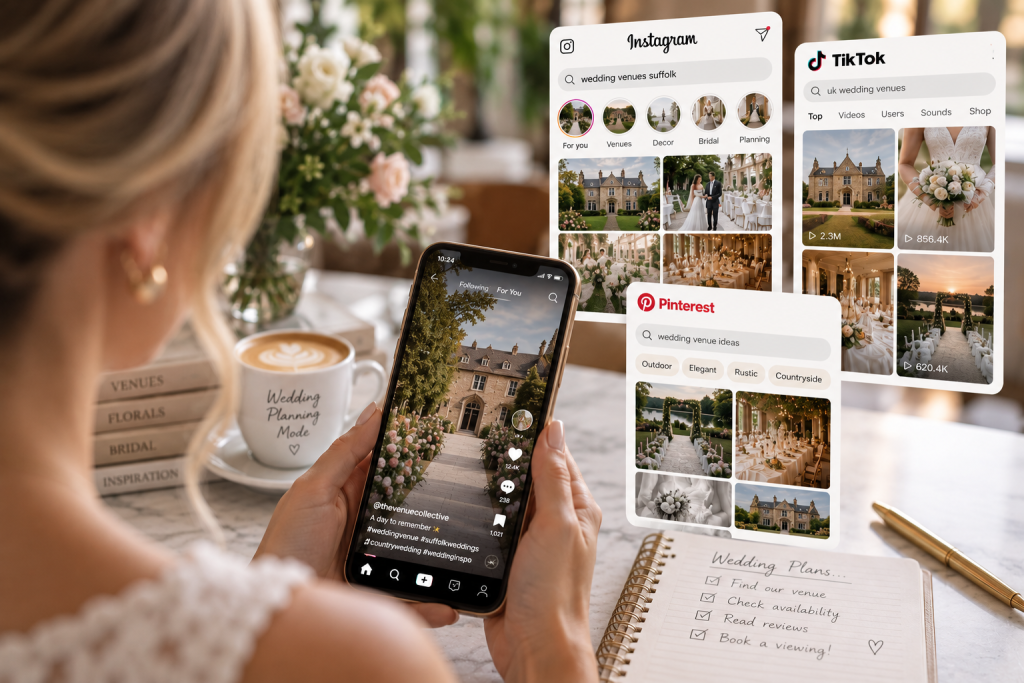
Instagram and TikTok have always been important for wedding inspiration, but they are increasingly becoming discovery platforms in their own right.
A 2026 dataset from Bredenbury Court Barns provides an interesting example. Among 58 stated referral sources from couples requesting venue viewings between May and August 2026, Instagram accounted for 29.3% of mentions, compared with 24.1% for Google Search, while TikTok accounted for 8.6%. This is one venue’s data rather than an industry-wide benchmark, but it demonstrates the potential importance of social discovery.
The implication isn’t that every wedding business should abandon Google and move its entire marketing budget to TikTok.
It’s that discovery is no longer linear. A couple might see your Reel, search your name on Instagram, look through tagged photographs, read your reviews and then visit your website. Your social content therefore needs to make sense to someone discovering you for the first time. Your location, what you offer and what makes you different should be clear from the content itself. And when it comes to video, don’t just show the finished product. Show the experience. Couples want to imagine arriving at the venue, getting ready, walking down the aisle, sitting down for dinner and dancing later that evening.
4. Couples want information before they enquire
One of the biggest changes wedding businesses need to respond to is the growing expectation that useful information should be available online.
A UK Wedding Industry Report found that 40% of couples surveyed said they would not enquire with a wedding business if pricing wasn’t available on its website, compared with 30% in the previous year’s research.
That doesn’t necessarily mean every venue needs to publish every package and upgrade online. But it does suggest that couples are increasingly unwilling to invest time in businesses when they have no idea whether they are within budget. The same principle applies to reviews. A venue can tell couples that its food is excellent, its team is helpful and its setting is beautiful, but previous couples saying those things carries considerably more weight. Don’t leave reviews sitting on Google. Use them alongside real wedding photographs, on relevant website pages and within social content. Turn customer experiences into evidence of what your business actually delivers.
5. AI will become part of marketing – but personality will matter more
By 2027, using AI to support marketing will be completely normal.
For smaller wedding businesses, that can be a huge advantage. AI can help with research, content planning, first drafts, reporting, repurposing content and repetitive administrative work. The danger is allowing it to make every business sound the same. If every venue uses AI to write its website copy and social captions, the industry will quickly fill up with beautifully polished but completely interchangeable marketing. The answer isn’t to avoid AI. It’s to use it for efficiency while keeping the human part of the marketing firmly in place.
Use AI to help turn a real wedding into multiple pieces of content. Use it to analyse your enquiry data or structure a blog. Use it to save your team time. But make sure the stories, experience, opinions and personality still come from your business. AI should make your marketing more efficient, not less authentic.
6. Don’t abandon SEO – make it work alongside everything else
The rise of AI search has led some businesses to assume traditional SEO is finished.
It isn’t.
Google’s own guidance confirms that established SEO practices remain important for its AI experiences, including technically accessible websites, useful content and original information. The bigger change is that SEO now sits within a much wider discovery journey. A couple might find you through Instagram, search your business on Google, read reviews, encounter you on a wedding directory and then return to your website before enquiring. Your marketing needs to be consistent across all of those touchpoints.
Think less about “How do we rank this page?” and more about “How do we become the business this couple keeps finding?”

List Your Wedding Venue
Don’t see your venue with us? Contact us about getting listed today
Your own customer data is becoming increasingly valuable

There is one area of marketing that isn’t controlled by an algorithm: your own customer database.
Your social media followers are valuable, but you don’t own the platform. Search traffic is valuable, but Google can change how its results work. Advertising platforms can change their costs and algorithms.
Your CRM and customer data are different.
If you know who has enquired, what they were interested in, whether they booked and why they didn’t, you can market much more intelligently.
A venue can re-engage couples who previously enquired when new dates become available. A photographer can develop referral campaigns. A florist can market anniversary flowers. A venue can keep in touch with previous couples and create entirely new revenue opportunities.
As marketing becomes more fragmented, owning the relationship with your audience becomes more important.
What should wedding businesses do now?
You don’t need to completely reinvent your marketing strategy before 2027.
Start with the basics.
Review your website and make sure it answers the questions couples actually ask. Look at your content and identify where you can demonstrate genuine expertise rather than simply producing more generic posts. Make your social content useful to someone discovering your business for the first time, and make better use of the real weddings, reviews and customer stories you already have.
Then look at your data. Do you know where your enquiries come from? Do you know which channels generate bookings rather than simply likes and views? Do you know why couples choose another business?
Finally, start using AI deliberately. Let it save your team time, but don’t let it remove the personality that makes your business different.
The future of wedding marketing isn’t about being everywhere
There will always be another platform, another algorithm and another marketing trend.
The temptation will be to chase all of them.
But the businesses that are best prepared for 2027 won’t necessarily be the ones producing the most content or appearing on the most platforms. They’ll be the ones that understand how couples actually make decisions and create a joined-up experience around that behaviour.
Search, social media, reviews, video, email, directories and your website aren’t separate experiences from the customer’s perspective.
They’re all part of the same journey.
The opportunity for wedding businesses is to make that journey as useful, trustworthy and memorable as possible.
Because the future of wedding marketing isn’t about being everywhere.
It’s about being the business couples keep finding, remembering and ultimately choosing.
List Your Wedding Venue
Don’t see your venue with us? Contact us about getting listed today