


Wedding Enquiries: How to Convert More Leads Into Bookings
NB: To help you browse our best suggestions we have included some third party links. Some purchases made through these links may earn us a commission to help keep our blogs and offers current and up to date. Thanks for your support!
For wedding venues, generating enquiries is only half the job. The real commercial opportunity comes from what happens after a couple clicks “enquire”.
This is becoming increasingly important as couples have more choice and more information available to them than ever before. Research from the UK wedding industry found that couples digitally view an average of 14.3 wedding venues before getting married, contact around 6.5 venues, read approximately 33 reviews, and attend just 3.2 in-person tours.
That tells us something important about the modern wedding enquiry. By the time a couple contacts your venue, they have probably already compared you with several competitors. They may know roughly what you charge, have looked at your reviews, explored your Instagram and decided which venues they want to visit.
Your enquiry response therefore isn’t simply customer service. It is another stage of your marketing and sales process.
The question is: are you making it easy for couples to choose you?
Speed matters, but don't confuse speed with good service
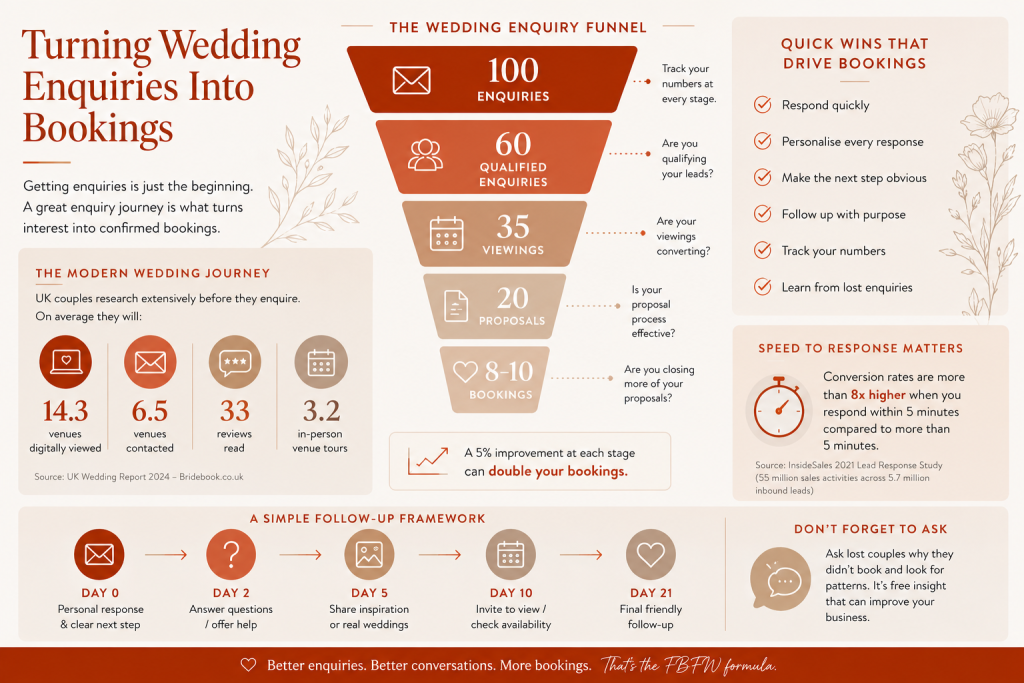
There is a strong body of sales research demonstrating that the value of an inbound enquiry can decline quickly when businesses take too long to respond. InsideSales’ 2021 Lead Response Study analysed more than 55 million sales activities across 5.7 million inbound leads at more than 400 companies and found that conversion rates were more than eight times higher when an initial response was attempted within five minutes compared with waiting beyond five minutes.
It’s important not to take that statistic and assume that responding to a wedding enquiry within five minutes will automatically make a venue eight times more likely to book a wedding. The research covers sales leads across a broad range of businesses rather than wedding venues specifically. What it does demonstrate very clearly, however, is the importance of responding while someone’s intent is still high.
Think about what happens when a couple enquires with your venue on a Saturday morning. At that moment, they are actively thinking about their wedding. They are probably sitting together, discussing dates and looking at venues. If your response arrives five minutes later, you’re participating in that decision-making process. If it arrives two days later, they may already have had conversations with several other venues.
The practical target for a wedding venue should therefore be simple: acknowledge immediately and aim for a genuinely personal response as quickly as your team can manage.
An automated acknowledgement can deal with the first part, but it shouldn’t be the end of the process. The research itself warns against confusing automation with meaningful engagement; the aim is to use technology to make your team faster, not to replace the human response.
Your first response should sell the next conversation
One of the most common mistakes in wedding sales is treating the first response as an information delivery exercise.
A couple fills in an enquiry form, the venue sends a brochure, pricing information and a link to the website, and the email ends with “We look forward to hearing from you.”
The information may be perfectly useful, but the couple is now left to decide what happens next.
A stronger response uses the information the couple has already provided to move the conversation forward. If they have given you a date, confirm whether it is available. If they’ve told you they are expecting 100 guests, acknowledge that and explain how the venue works for that number. If they have mentioned wanting an outdoor ceremony, show them an example of one.
Most importantly, give them a clear next step.
That might be a viewing, a call with the wedding team, a date-holding conversation or simply an invitation to reply with a couple of questions. The objective isn’t to force a booking from the first email; it’s to make the next stage of the decision as easy as possible.
A useful test for your enquiry response
Before sending your next template, ask whether it answers these five questions:
- Have we confirmed what the couple asked us?
- Have we shown that we have actually read their enquiry?
- Have we given them enough information to understand the opportunity?
- Have we given them a reason to continue the conversation?
- Have we made the next step obvious?
If the answer to the final two is no, your response probably needs work.
Stop following up with “just checking in”
A couple not replying to an enquiry doesn’t necessarily mean they’ve chosen someone else.
Wedding planning is a long process, and couples are often coordinating budgets, families, dates and dozens of suppliers simultaneously. A venue that sends one response and then quietly closes the enquiry may simply be giving up too early. At the same time, persistent follow-up can quickly become irritating when every message says essentially the same thing.
The solution is to think about follow-up as a journey rather than a series of reminders.
Your first message should deal with the enquiry itself. A subsequent message could answer a question you know couples commonly have. Another could introduce a relevant real wedding or showcase a part of the venue that matches what the couple described. Later, you might invite them to a viewing or let them know about availability.
The important point is that every communication should have a reason for existing.
InsideSales’ 2021 research found that 81% of sellers made five or fewer follow-up attempts, while seven or more attempts generated 15% more connections in its dataset. Again, this isn’t a wedding-specific benchmark, but it does challenge the idea that one or two attempts are necessarily enough.
For venues, the lesson isn’t that every couple should receive seven emails. It’s that your team should have a defined process for following up rather than relying on individual salespeople to remember when to contact someone.
Know your numbers before you spend more on marketing
If you asked most wedding venues how many enquiries they received last month, they could probably find the answer. Ask how many of those enquiries became bookings, and the answer may be less immediate.
That is a problem.
Enquiry numbers tell you how much interest your marketing is generating, but they don’t tell you how effectively your business is converting that interest into revenue. At the very least, every venue should be able to calculate:
Enquiry-to-viewing conversion – How many enquiries result in a viewing or sales appointment?
Viewing-to-booking conversion – How many couples who visit actually book?
Enquiry-to-booking conversion – What percentage of all enquiries ultimately become confirmed weddings?
Average booking value – How much revenue does each confirmed wedding generate?
These numbers become particularly useful when you look at them together. Imagine two venues both receive 200 enquiries a year. Venue A converts 10% into bookings, giving it 20 weddings. Venue B converts 15%, giving it 30. The second venue has generated 50% more bookings without generating a single additional enquiry. That’s why improving conversion can be just as commercially important as increasing traffic or lead generation.
Try this with your own data
Take your last 12 months of wedding enquiries and create a simple funnel:
Enquiries → Qualified enquiries → Viewings → Proposals → Bookings
Then calculate the percentage that moves from one stage to the next. You may find that your biggest marketing problem isn’t marketing at all. It might be your sales process.
Your lost enquiries are valuable research
There is another number worth tracking: why couples don’t book.
It’s surprisingly common for businesses to mark an enquiry as “lost” without recording what actually happened. That means potentially valuable customer research disappears every time a couple chooses another venue. Instead, introduce a simple lost-lead process. When a couple tells you they’ve chosen elsewhere, ask whether they’d be willing to share what influenced their decision.
You don’t need a long questionnaire. One useful question is enough:
“If you’re happy to share, what was the main factor that influenced your decision?”
After you’ve collected enough responses, categorise them. Price, availability, location, venue style, package, competitor, communication and viewing experience are all useful starting points. Patterns will emerge. If a significant number of couples say they couldn’t understand your pricing, that’s something your website and sales materials can address. If they repeatedly mention another venue’s flexibility, perhaps your packages need reviewing. If communication appears repeatedly, the problem may sit much closer to home.
The important thing is not to treat every lost enquiry as an individual failure. Look for patterns across the data.
The website still has a job to do after the enquiry
The enquiry may have happened, but the couple hasn’t stopped researching.
In fact, given that UK couples are researching an average of more than 14 venues digitally and reading around 33 reviews, there is a good chance that your website and social channels will continue influencing their decision after they contact you. This is why your digital presence needs to support the sales process rather than simply generate leads.
If your enquiry response mentions an outdoor ceremony, can the couple immediately find photographs and information about it? If you’ve told them about your accommodation, can they see the rooms online? If you’re asking them to book a viewing, are there real couples’ experiences and reviews that reinforce why they should? Your website should answer the questions that appear between enquiry and booking. This is also where real wedding content becomes particularly valuable. A couple doesn’t just want to know what your venue looks like; they want to understand what their own wedding could look and feel like there.
Your 30-day wedding enquiry audit
If you want to improve your enquiry conversion rate, don’t overhaul your entire sales process overnight. Start by measuring what is already happening.
Week 1: Measure. Record your enquiry numbers, response times, viewing numbers and bookings, and calculate your current conversion rates.
Week 2: Improve response time. Set an internal target for how quickly enquiries should receive a meaningful response, and use automation where appropriate to prevent enquiries sitting unnoticed.
Week 3: Review your follow-up. Map out what happens after the first response. If the answer is “nothing unless they reply”, you’ve found an immediate opportunity.
Week 4: Analyse lost leads. Review recent enquiries that didn’t convert and identify the most common reasons. Then use those findings to improve your marketing, website, packages or sales process.
More enquiries aren’t always the answer
The instinct when bookings are down is often to increase marketing activity. More advertising, more social content, more SEO, more website traffic and, ultimately, more enquiries.
Sometimes that’s exactly what a business needs. But if your conversion rate is weak, generating more enquiries simply puts more potential customers into a leaky sales funnel. Before spending another pound on lead generation, find out what happens to the enquiries you already receive.
How quickly are you responding? What does your first response actually say? How many times are you following up? How many enquiries become viewings? How many viewings become bookings? And, most importantly, do you know why the couples who don’t book choose someone else?
These are much more useful questions than simply asking whether you need more leads. The strongest wedding businesses will always need effective marketing to attract couples, but the venues that consistently turn that attention into revenue will be the ones that pay equal attention to what happens afterwards.
Get the couple through the door. Give them a reason to stay. Make the next step easy. Then use the data to keep improving.
Because the next booking you win may not come from finding another enquiry.
It may come from converting the one that’s already sitting in your inbox.

List Your Wedding Venue
Don’t see your venue with us? Contact us about getting listed today